Overview
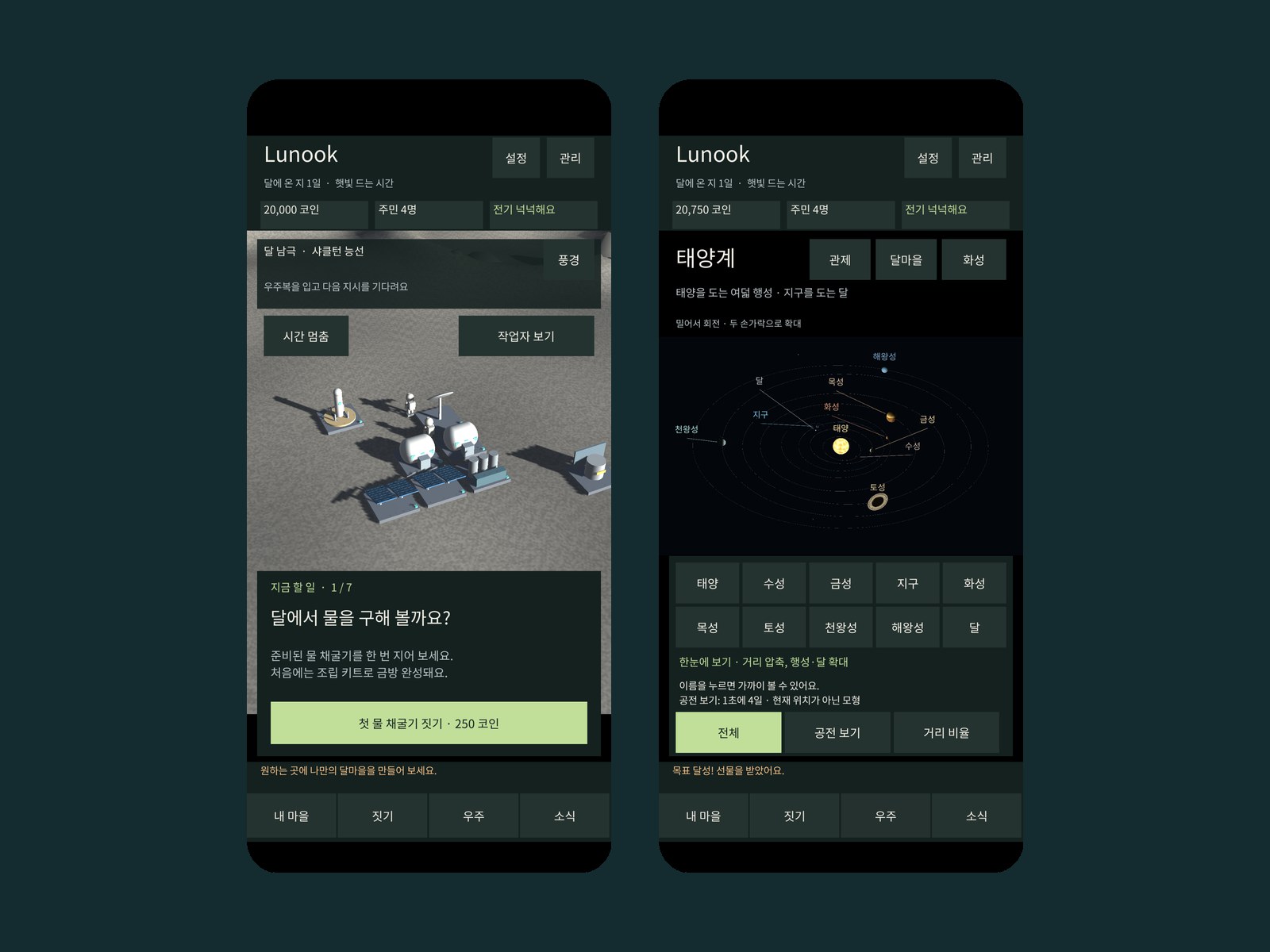
An iOS space-settlement sim where you build a village on the Moon, manage residents and resources, and travel between Earth, the Moon, and Mars. Working solo with AI on a total budget of KRW 200,000, I owned planning and business decisions and split implementation across several AI agents, including Claude Code and Codex.
Problem
The first plan was a hard-SF business sim that included the laws of physics, time compression, and even communication delays. But once I built a prototype, the problem was clear: it “looks too hard.” And I couldn’t change direction without evidence of what wears out players of mobile management games.
Approach
I analyzed 30,188 reviews of 19 space and city-building games and confirmed that players get worn out by ads and wait times, so I decided on wait-for-free timers, free building relocation, and no ads or time-skip tickets. I tracked the 54 decisions that departed from the original plan, with reasons, in a design change log, and set a single-source rule: physics values, time constants, and MVP scope are each defined in only one document. I worked on the planning documents with Claude Code and on the prototype, business model, naming, and marketing documents with Codex, passing outputs between agents and approving decisions. Because of the budget, I made the models with Blender scripts instead of 3D generative AI, and made the sound effects myself in Python.
Results
With Unity 6.3 and a deterministic simulation core in pure C#, I built it up to v0.10 (build 10) in 8 days. It has a build-and-manage loop, a solar-system view based on Keplerian orbits, rocket travel (launch windows, ignition gauge, landing), and observatory challenges, and I verify it with 967 pure C# tests plus 5 real-touch E2E flows on iOS by comparing save files. I designed the business model as a free, complete main game + permanently owned expansion packs, and after comparing with competing games, lowered the planned price from KRW 7,900 to KRW 5,900. It is at the prototype stage, with no payments or store materials yet.
Lessons Learned
I pivoted on review data, not gut feel, and recorded every changed decision. When working with several AI agents, a planner’s job wasn’t writing code but using single-source documents and decision logs to make the agents build the same game.